
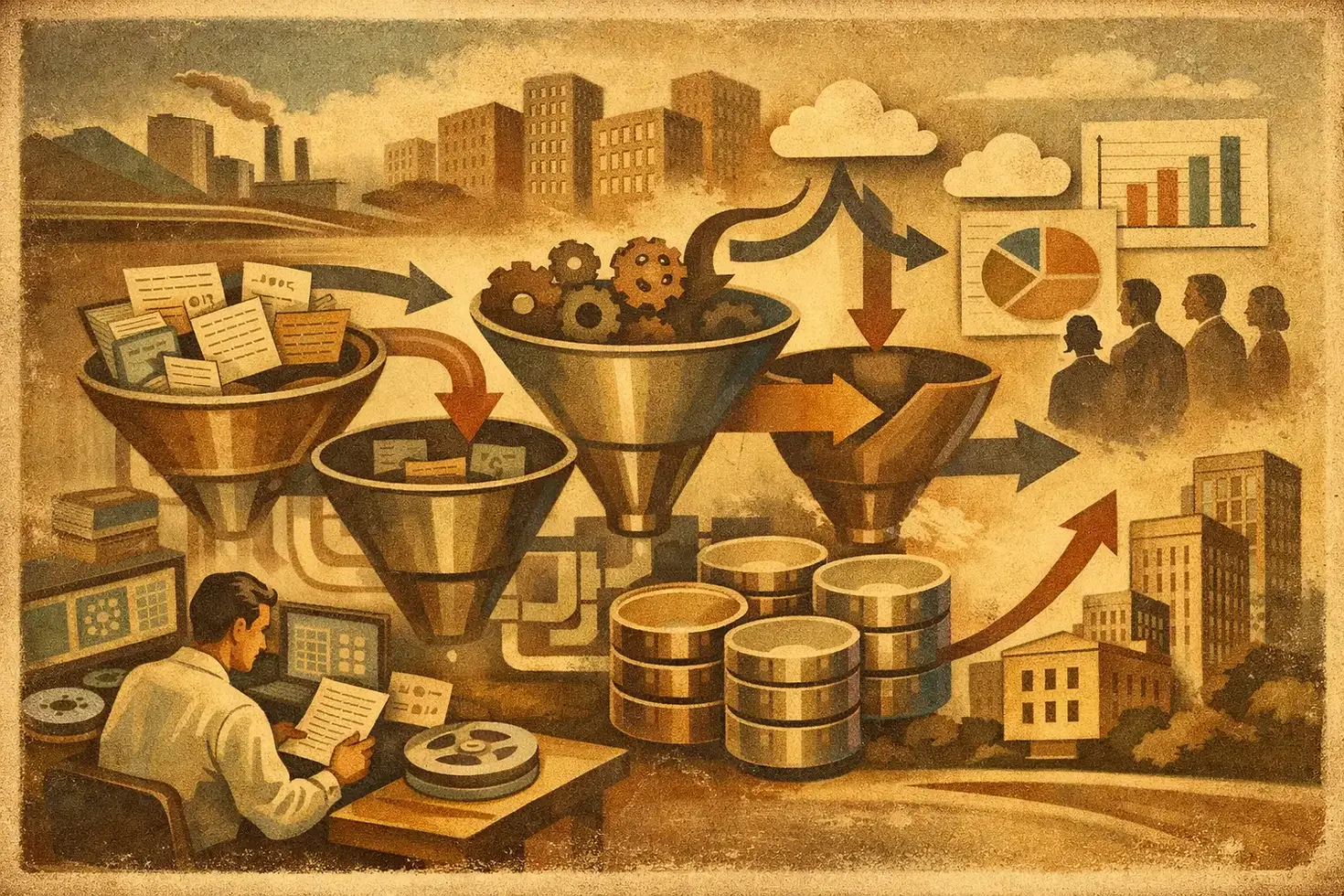
How to Design ETL Workflows for Business Scale

A monthly executive report that changes after it is published is not a reporting problem. It is an ETL design problem. When leaders ask how to design ETL workflows, the real objective is to create a dependable path from operational data to decisions - without manual fixes, unexplained numbers, or rising maintenance costs.
For most organizations, the challenge is not extracting data from one system. It is coordinating data from finance, sales, operations, customer platforms, and external sources while preserving meaning, accuracy, and traceability. A well-designed ETL workflow turns that complexity into a repeatable operating capability.
Design ETL workflows around business decisions
Start with the decisions the workflow must support, not the source systems available. If the business needs to understand customer profitability, on-time delivery, inventory exposure, or sales pipeline conversion, define those outcomes before selecting tables, tools, or transformation logic.
This approach prevents a common failure mode: building broad data pipelines that move large volumes of data but do not produce trusted metrics. Every workflow should have a clear consumer, a defined reporting or operational use case, and an owner responsible for validating whether the output is fit for purpose.
For each priority outcome, document the business definitions behind the metrics. Revenue may mean booked revenue, invoiced revenue, recognized revenue, or collected revenue depending on the audience. A workflow can run perfectly from a technical perspective and still create costly confusion if those definitions are not agreed upon.
The initial design should answer three practical questions: What decision will this data support? How current must the data be? What level of accuracy is required? An executive financial report may require fully reconciled daily data, while an operational dashboard may benefit more from hourly updates with a clearly stated refresh status.
Map sources before building transformations
Source assessment is where many ETL projects either gain control or accumulate technical debt. Inventory each source system, its data owner, update frequency, access method, volume, and known quality issues. Include spreadsheets and manual exports. They are often critical to reporting even when they are not formally recognized as systems of record.
A useful source map identifies where each key field originates and whether it can be trusted. Customer ID, product code, order status, currency, and transaction date may exist in multiple systems with conflicting formats or meanings. Do not assume matching column names represent matching business concepts.
Identify the system of record
For each important entity, designate a system of record. The CRM may own account attributes, the ERP may own invoices, and a warehouse management system may own fulfillment events. Where no single system is authoritative, the workflow needs explicit matching, survivorship, and exception rules.
This is especially important for master data. If a customer appears under slightly different names in sales, finance, and support platforms, joining records by name will eventually distort reporting. Use stable identifiers where possible. When identifiers do not align, introduce a controlled mapping process rather than embedding ad hoc fixes across multiple reports.
Profile data early
Data profiling should occur before transformation development, not after stakeholders question the numbers. Review null rates, duplicates, unexpected values, date ranges, record counts, and format inconsistencies. A simple profile can reveal that a supposedly required field is frequently empty or that historical data uses different coding standards.
Early profiling also clarifies effort. A source with clean, stable APIs may be suitable for frequent incremental loads. A legacy database with inconsistent timestamps and late updates may need a different extraction strategy and more reconciliation controls.
Choose an ETL architecture that fits the workload
There is no universal architecture for every data environment. The right design depends on data volume, refresh requirements, transformation complexity, compliance needs, team skills, and cloud platform strategy.
A layered pattern is often effective. First, land source data in a raw layer with minimal changes. Next, standardize and validate it in a curated layer. Finally, publish business-ready models for analytics, reporting, or downstream applications. This separation makes it easier to troubleshoot issues, rerun transformations, and preserve source history.
For many organizations, cloud data platforms provide the flexibility to scale storage and compute independently. However, cloud adoption does not remove the need for disciplined architecture. Loading every source directly into a reporting model can produce fast early results but creates difficult-to-maintain dependencies as requirements grow.
Batch processing remains appropriate for many finance, operational, and management reporting workloads. It is often less expensive and easier to validate than near-real-time processing. Streaming or event-driven workflows make sense when the business case demands immediate action, such as fraud detection, order status updates, or time-sensitive alerts. The key is to match refresh frequency to business value, not to pursue real time as a default.
Build transformations for accuracy and reuse
Transformation logic should be understandable, testable, and reusable. Avoid placing core business rules only inside dashboard calculations or individual analyst queries. When logic is distributed across reporting tools, the organization loses a consistent version of the truth.
Standardize common activities such as date handling, currency conversion, status mapping, data type enforcement, and deduplication. Centralizing these rules reduces repeated effort and makes updates safer when business definitions change.
Incremental loading is another critical design choice. Instead of reprocessing every record on every run, capture new and changed data based on reliable change markers. These may include update timestamps, sequence numbers, change data capture feeds, or source-specific audit fields.
But incremental logic requires care. Late-arriving records, corrected transactions, deleted records, and changed historical attributes can all create gaps if the process only loads records with a timestamp greater than the last successful run. In many cases, a rolling lookback window or change tracking mechanism is more reliable than a single watermark.
Historical tracking should also be intentional. Some dimensions, such as customer segment or employee department, may need current values only. Others require history to explain past reporting accurately. If a customer changes territory, should last quarter's revenue move to the new territory? The answer depends on the business question, which is why transformation design must involve business owners as well as technical teams.
Engineer quality checks, recovery, and observability
A workflow is not production-ready because it ran successfully once. It needs controls that detect failures before they reach business users. Establish checks at the source, transformation, and target stages.
Effective validation includes record counts, duplicate checks, required field checks, referential integrity tests, accepted value rules, and reconciliation to source totals. For financial or operationally sensitive data, compare key measures such as invoice amounts, units shipped, or open order counts against source-system reports.
Quality checks should have clear outcomes. Some failures should stop the pipeline, such as a missing critical source file or a major drop in record volume. Others may allow the process to complete while raising an alert for review. The threshold depends on the importance of the dataset and the cost of delayed reporting.
Recovery design matters just as much. Workflows should be idempotent, meaning a failed load can be rerun without creating duplicate or inconsistent records. Keep run metadata that records start and end times, row counts, statuses, error details, and the source data range processed. This gives technical teams a practical audit trail and shortens issue resolution.
Observability should extend beyond job status. A green check mark only confirms that the orchestrator completed its steps. It does not confirm that data was complete, timely, or correct. Monitor freshness, volume trends, quality-rule failures, processing duration, and cost. These measures reveal whether the platform is meeting its business commitments.
Protect sensitive data and control costs
ETL workflows frequently handle customer information, employee records, financial data, and confidential operational details. Apply least-privilege access from the beginning. Separate development, test, and production environments, protect credentials through managed secrets, and restrict sensitive fields to users and systems that genuinely need them.
Where analytics does not require direct personal information, use masking, tokenization, or aggregated datasets. Security design should support usable analytics, not block it. The goal is controlled access to the right information for the right purpose.
Cost management also belongs in the workflow design. Inefficient queries, unnecessary full reloads, overprovisioned compute, and repeated transformations can increase cloud spend quickly. Establish workload schedules, use incremental patterns where appropriate, and monitor compute consumption by pipeline and business domain. The least expensive pipeline is not always the right one, but cost should be visible and connected to the value delivered.
Treat ETL as a managed business capability
ETL workflows need ownership after deployment. Assign responsibility for platform operations, source-system changes, data definitions, and business validation. A new ERP field, changed CRM picklist, or revised pricing rule can affect downstream data long before a dashboard visibly fails.
Document the workflow at a level that supports handover and change management: source-to-target mappings, business rules, schedules, dependencies, quality controls, and recovery procedures. Documentation is not a substitute for sound design, but without it, even a well-built pipeline becomes difficult to operate as teams change.
The strongest ETL environments improve over time. Start with the workflows that support high-value decisions and remove the most manual, error-prone reporting effort. Then use operating metrics, user feedback, and source changes to refine the architecture. That steady discipline is what turns data movement into dependable business intelligence.


Comments